HIGGS AND BSM
The strangest particle in the SM and beyond

The scientific field of elementary particle physics deals with some of the deepest questions formulated by mankind.
- What are the most fundamental building blocks of nature?
- What are the forces acting between them?
- How did the universe start, how did it evolve, how will it end?
Decades of theory progress and experiments at high-energy colliders and elsewhere allow to answer these questions.TheStandard Model( SM) of particle physics provides a consistent description of the most fundamental constituents of matter and of their interactions.The particles of the StandardModel have been confirmed in experiments and their properties have been measured with high accuracy.In some cases, measurements have been compared to the Standard Model with a precision of 10 digits or more, making the Standard Model by far the most precise theory ever formulated.
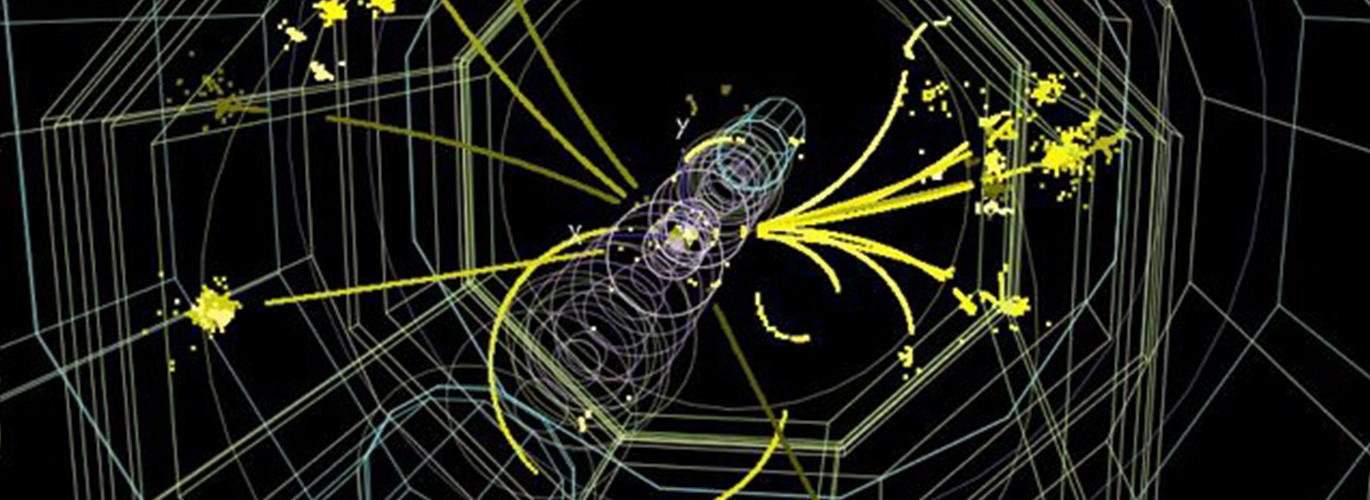
For theoretical consistency, the Standard Model requires the existence of the Higgs field, which is responsible for the masses of elementary particles through their interactions with it. In 2012, the experiments at the CERN LHC discovered a new particle whose properties are, within theoretical and experimental uncertainties, consistent with those of the Higgs boson, with a mass of about 125 GeV. However, current measurements still leave significant room for extensions of the Standard Model.
A central priority of high-energy physics is therefore the precise characterisation of the Higgs sector. Future electron-positron colliders will provide an exceptionally clean environment in which to measure Higgs couplings with unprecedented precision, search for deviations from Standard Model predictions and probe the possible existence of additional Higgs states or other manifestations of new physics.
This physics case has been a major driver of the international future-collider programme. In Europe, the 2026 Update of the European Strategy for Particle Physics identifies FCC-ee as the preferred option for the next flagship collider at CERN, providing a precision programme spanning Higgs, electroweak and top-quark physics. Complementary capabilities could also be provided by a future Linear Collider Facility (LCF).
The combination of direct searches and high-precision measurements at these facilities offers sensitivity to new physics scales well beyond those that can be accessed directly, making the Higgs sector one of the most powerful probes of physics beyond the Standard Model.